Most people, perhaps every human, are familiar with the Gaussian curve in some form. Some encounter it during their studies in mathematics or statistics, while others first hear about it in the corporate world.

I was first introduced to this concept in my mathematics and statistics classes. At that time, it was simply a theoretical model, elegant, symmetrical, and predictable. However, I gained a deeper understanding of it later.
The curve appears simple and logical on paper. But when applied rigidly to real-world processes, it can lead to unintended consequences.
This blog is inspired by one such personal unintended consequence.
Short History of the Gaussian Curve
The Gaussian curve, also known as the normal distribution or bell curve, traces its origins to the work of Abraham de Moivre in the 18th century. While studying probability in 1733, he discovered that the binomial distribution begins to resemble a bell-shaped curve when the number of observations becomes large.
Later, Pierre-Simon Laplace expanded this idea and showed that many natural phenomena tend to follow this distribution, a concept that eventually became known as the Central Limit Theorem.
The curve gained its name from Carl Friedrich Gauss, who used it in the early 1800s to analyze errors in astronomical observations. His work made the distribution widely known, and it eventually became one of the most important concepts in statistics.
Today, the Gaussian curve is used across fields ranging from science and engineering to economics.
One day, around five or six years ago, I learned that I was not being promoted to a senior role.
What does a normal employee do in such a situation?
Ask their reporting manager for the reason.

I did the same.
In response, I was told something interesting:
“I have given you a rating strong enough for promotion. However, once all employee ratings were passed through the Bell Curve, your rating dropped, and as a result, your promotion was delayed.”
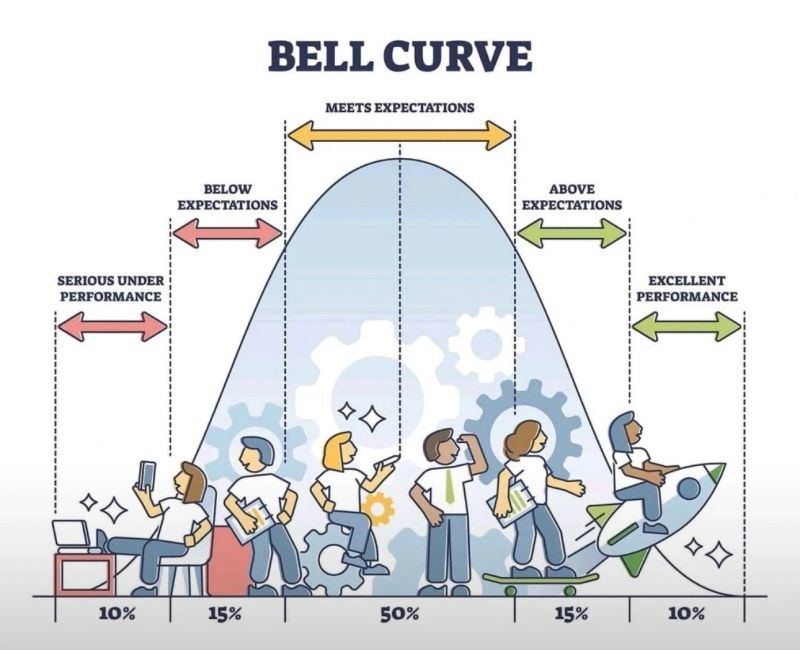
That was my first real encounter with the Bell Curve outside a textbook. So my performance depends on others performance too.
That conversation made me think.
Why do we make our systems so complex?
Why should my promotion depend on the ratings of others?
Why can’t it simply be a clear yes or no, based on performance, instead of being forced through a Bell Curve?
These questions stayed with me for a long time.
In mathematics, the Gaussian curve helps us understand patterns in data.
But when we start using it to judge human potential, we must pause and ask, are we measuring performance or merely forcing people to fit a distribution?
Sometimes the problem is not the curve.
The problem is where we choose to apply it.
If the Bell Curve explains how data behaves, should it really decide how people progress?
 Blogpost's By Anoop