For a long time, scientists believed they had already reached the deepest level of matter. Atoms had been discovered, and later it became clear that atoms themselves were made of smaller particles—electrons, protons, and neutrons. These were considered the fundamental building blocks of matter, the smallest pieces that could not be divided any further.
However, science has a habit of revealing deeper layers whenever we look more closely. As experimental techniques improved and powerful particle accelerators were developed, physicists began probing inside the proton and neutron. What they found was surprising: these particles were not elementary after all. Instead, they were composed of even smaller constituents called quarks.

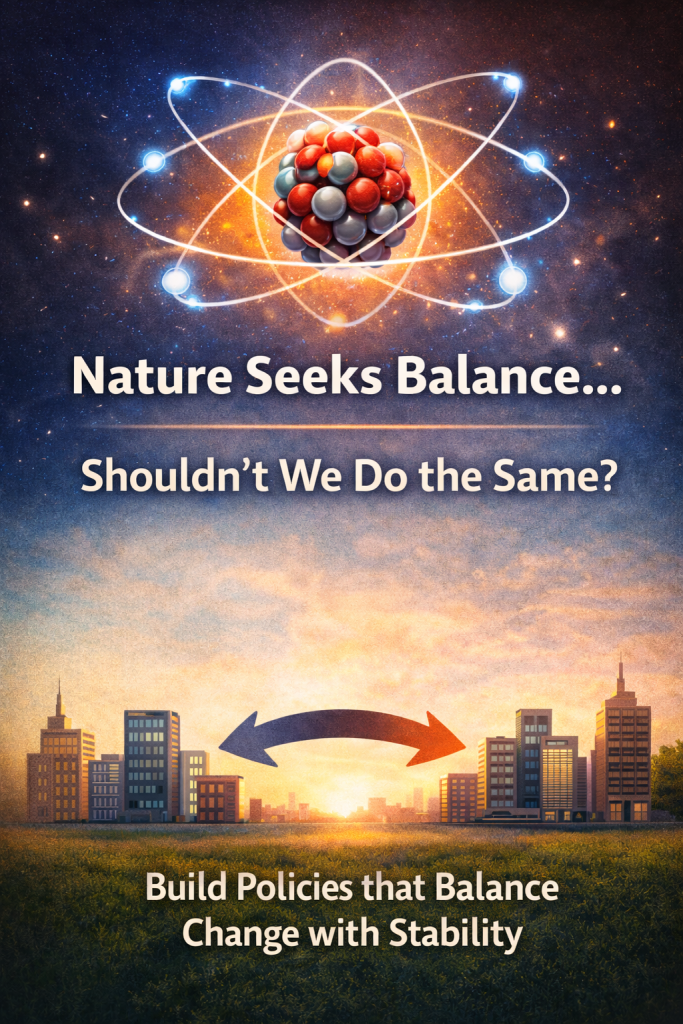
For the purpose of this discussion, let us consider electrons, protons, and neutrons as the smallest meaningful units of matter. In nature, these particles constantly interact with one another, forming stable structures such as atoms and molecules. Stability is achieved through balance—particles pair, share, or exchange energy to create systems that are more stable than isolated components. Nature, in this sense, always moves toward equilibrium.
If even the smallest particles of the universe seek stability, it raises an interesting question for human organizations. Why do we sometimes design systems and policies that disrupt stability instead of supporting it? One such policy is location based transfer.
When employees form productive teams, develop expertise at a location, and establish social and professional balance, transfers can disturb that equilibrium. Perhaps organizational policies, like natural systems, should aim not merely at movement and control but at maintaining stability while enabling growth.
Nature constantly seeks equilibrium. Even the smallest particles interact in ways that create stable systems. Human organizations, however, operate in a much more complex environment where stability and operational needs often compete with each other. As organizations began to grow larger, especially during the expansion of industries and multi-location enterprises, a new challenge emerged: how to manage people across different geographical locations.
Managers realized that sending trained employees to new locations could help establish systems, transfer knowledge, and maintain organizational standards. This practical requirement gradually gave rise to location-based transfers.

What initially started as an operational necessity slowly evolved into a structured administrative practice, eventually becoming a formal component of modern human resource management.
Over time, however, the context in which these policies operate has changed. Many organizations now have well-established systems and capable teams across different locations. In such cases, location-based transfers are sometimes implemented even when both locations are already functioning efficiently, raising the question of whether the policy is always aligned with its original intent.
Employees working in such environments may gradually begin to feel a sense of uncertainty. When the possibility of relocation remains constant, even without a clear operational requirement, it can create a subtle but persistent feeling of instability. Over time, this uncertainty can influence how individuals plan their personal lives, build professional relationships, and develop long-term commitment to their workplace.
If atomic particles can get stability, then why cannot an employee get a sense of stability?
 Blogpost's By Anoop